2026-02-02
We Mapped a New Forestry System for BC
What does a different forestry system actually look like on the ground?
That question comes up a lot - especially when people hear about the New Forest Act and its Protect–Restore–Harvest (PRH) framework for the first time. It’s one thing to talk about systemic change in the abstract. It’s another to show how it would actually work in a real place, using real data and real constraints.
That’s why we undertook this mapping analysis.
In a new video, we walk through a detailed spatial analysis of the Kettle River watershed in southern British Columbia, showing how the New Forest Act framework could be applied using existing provincial datasets. The goal was not to produce a land-use plan or make site-specific decisions, but to make the logic of the system visible - something that’s largely missing from how forestry decisions are made today.
You can watch the full video here:
👉 [Watch: We Mapped a New Forestry System for BC]
Why the Kettle River watershed?
We chose the Kettle River watershed deliberately.
It’s a large, mountainous watershed - about 8,000 square kilometres - with a long history of industrial logging, high road density, and well-documented cumulative impacts. It’s also a watershed we know well. In 2021, our organization published a field report after ground-truthing more than twenty sites across the region, supported by retired loggers and people with deep on-the-ground experience.
The Kettle has also been the subject of extensive hydrological research, including work by Dr. Younes Alila at UBC, showing how logging and forest road density in headwater areas can dramatically increase flood risk downstream. The catastrophic 2018 flood in Grand Forks made those cumulative impacts impossible to ignore.
In short, this is not a hypothetical case. It’s a watershed where the science, field evidence, and lived experience all point in the same direction: how forests are managed matters - especially at the watershed scale.
What this mapping analysis does (and does not do)
This work is not a land-use plan or a zoning order. And it is not being imposed on anyone.
What it is, is a worked example.
Using publicly available provincial data, forester-in-training and spatial analyst Yudel Huberman, MF, independently applied the Protect–Restore–Harvest framework to the Kettle River watershed. The analysis shows what changes when you move away from a volume-driven system - one focused on maximizing the Timber Harvesting Land Base (THLB) - and instead start with ecological limits, watershed risk, and long-term recovery.
The maps and accompanying analysis illustrate:
- How primary forests are identified and protected
- How previously logged and hydrologically stressed areas are placed into restoration
- Where careful, selection-based harvesting could still occur - and why that area is smaller by design
- How cumulative impacts, including road density and Equivalent Clearcut Area (ECA), affect decisions
- How local constraints like Special Management Zones and grizzly habitat inform outcomes
One of the key points is that PRH is not a one-size-fits-all model. The framework stays the same, but the outcomes differ from watershed to watershed depending on terrain, forest condition, hydrology, wildlife needs, and existing disturbance.
What about the numbers?
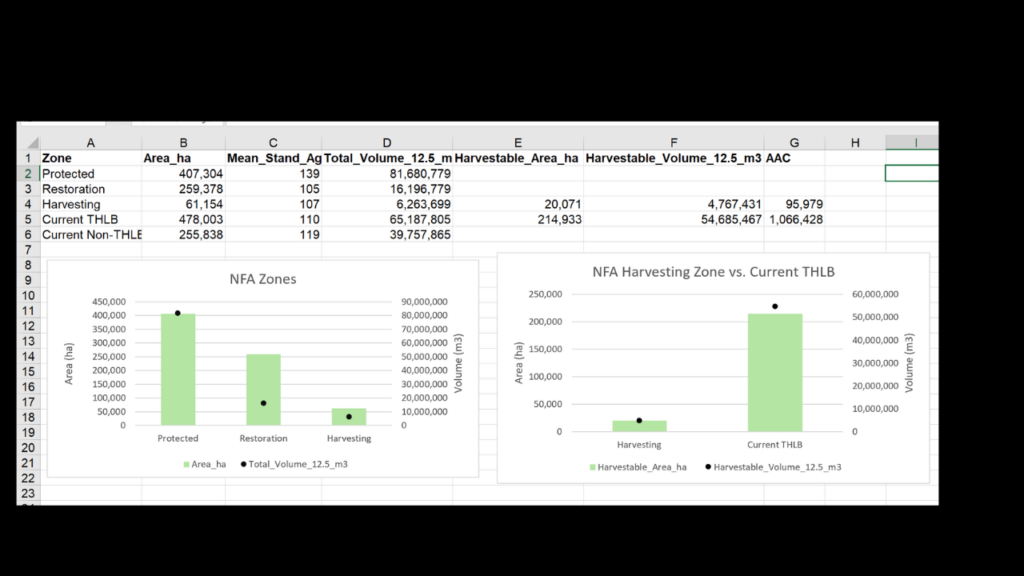
In the second half of the video, we walk through a spreadsheet that compares the current system with the PRH scenario for the Kettle watershed.
The numbers show a much smaller harvest area, an older average forest age, and a lower annual allowable cut than the current model - not because logging disappears, but because the system stops liquidating forests faster than they can recover.
These figures are comparative, not forecasts or targets. They’re meant to show direction and scale, not to fine-tune cut levels. In a different watershed, with different conditions, the numbers would look different - and that flexibility is the point.
We’ll be making the maps, logic document, and data tables available alongside the video so people can review them directly.
Why this matters
Most forestry decisions in British Columbia happen inside technical and bureaucratic processes that the public never sees. This mapping analysis does something different: it makes the decision-making logic visible.
It shows what changes when forests are treated as critical public infrastructure - the way we treat water systems or flood protection - rather than as a fibre supply problem to be optimized.
The forest industry is currently in the midst of a structural collapse. That collapse is being used to justify rushed approvals, weakened constraints, and more public subsidies for the same system that produced the problem. At moments like this, the real question becomes: what replaces it?
This mapping analysis is one way of answering that question.
Watch the full video
👉 We Mapped a New Forestry System for BC